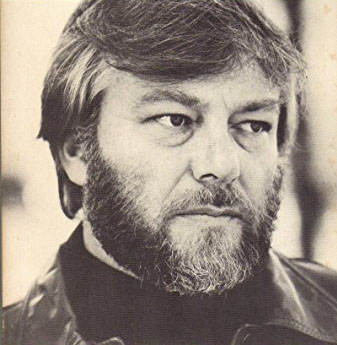
First Rites by Philip F. O’Connor

phil
Published SF Gate 4:00 am, Sunday, February 2, 1997

In the late spring of 1957, Martin Luther King Jr. was struggling to gain control of the budding civil rights movement. On a ridiculously smaller scale, I, then a cub reporter on the San Francisco News, was attempting to prove to myself and my editors that I could do more than write amusing feature stories. The young minister’s path and mine would cross – more accurately, I’d be thrown across his – the morning I was assigned to interview him at the Sir Francis Drake Hotel.

Though King had received national and international attention after the successful Montgomery bus boycott of 1956, his civil rights leadership rested on soft Alabama clay. Though later, the NAACP helped fund King’s Southern Christian Leadership Conference, in mid-’56, NAACP officials were publicly belittling the new organization, which they believed threatened their activities in the South.

During the NAACP’s 1956 convention, held at San Francisco’s Civic Auditorium, then-NAACP counsel Thurgood Marshall called King “a boy on a man’s errand.” Elsewhere, even the great African American leader W.E.B. DuBois said, “If passive resistance could conquer racial hatred . . . Gandhi and Negroes like King would have shown the world how to conquer war itself.”

Such not-so-friendly fire came on the heels of attacks by enemies in Montgomery. Segregationists had bombed King’s and other boycott leaders’ homes. When suspected bombers were arrested, a local court set them free. Death threats to King and his family soon became as common as bulk mail advertising. Police themselves began stalking and harassing the young leader, arresting him on charges that ranged from driving 30 mph in a 25-mile zone to conspiracy to prevent the operation of a business.

As if King needed more trouble, members of his Montgomery Improvement Association, the organization that the SCLC would replace, began bickering with each other. Some tried to back out of the boycott, and others charged King with excessive travel and getting too much attention. Discouraged by the problems he faced during this period, King would soon tell singer Harry Belafonte, “I don’t know where this movement is going.”

By spring 1957, despite having been praised in a Time magazine cover story, and profiled in the New York Times as well as appearing on Meet the Press, King had had little success spreading his message of nonviolence through the South. In frustration, he decided to capitalize on his new media attention by writing his autobiography, Stride Toward Freedom, and by scheduling numerous public appearances. He began to work at a manic pace, writing, traveling and speaking. By the end of the year, he’d cover 780,000 miles and give 208 speeches. One of his stops would be San Francisco.

I didn’t ask why I, the newspaper’s least experienced reporter, was being assigned to interview King; it didn’t even occur to me. I was 24 years old and King was only 27. Despite the worldwide attention he’d begun to receive, Martin Luther King still wasn’t big news here. In preparing this article, San Francisco Public Library researcher Kathy Laughin and I found only one news item about King and the bus boycott in 1957, prior to June – a single paragraph announcing that local ministers were sending the boycott leader a letter of support. The Examiner librarian found that the morning papers, the Chronicle and The Examiner (which was then still a morning paper), and the other afternoon paper, the Call-Bulletin, likewise gave the rising civil rights leader – and the Montgomery bus boycott – almost no coverage.

My path toward King began at a U-shaped table called the copy desk. In the U’s center stood a man who never, at least in my presence, cast a smile. I know he had a last name but doubt he had a first. Secretly, I called him “Hatchet.” Periodically, he folded up sheets of paper that had been churned out by the United Press or Associated Press wire service machines or been sent over from the city desk, wrote a word-number on the outside and, without even looking, slapped them hard onto one of the sharp foot-long nails that stuck up in front each of his cowering sub-editors. None of the sub-eds cowered more than I, or had more reason to.

Once, given the number “200” on a U.P. feature story by Merriam Smith about a golf game among President Eisenhower and his cronies, I cut out of the approximately 500-word piece every reference to government matters, like whether Ike thought the Air Force deserved to get a $22 million, as opposed to a $24 million, budget increase, and left in more personal material, like a reminiscence about Patton’s dog (The President puzzled over why “Willie” had always growled at him) and Ike’s mysterious distaste for breakfast sausages. ( “Lately,” said the president, “they seem to back up.” ) I was certain that readers would doze over the budget speculation. “Hatchet” had another notion. The sheets quickly re-descended onto my spike. A small note was scrawled across the top: “Delete everything (two underlines) you left in and put back everything (three underlines) you took out.”

I was soon transferred to the city desk. My first assignment was to investigate the report of a body at the bottom of a lightwell on Hayes Street. I went to an apartment building, opened a second-story window and looked down to see ghastly eyes staring up at me out of a gray face with blood trickling from its mouth. Ack! A suicide, police told me. For months afterward, I closed my eyes whenever someone was about to bite into a strawberry- or raspberry-filled doughnut.

Much troubled, I began to dislike news. News, it seemed to me, licensed any lunatic who wanted to burn down a building, shoot a politician or undress on Market Street to determine what I did, thought and wrote about on a given day. A real reporter’s test, it seemed to me, was going up to the devastated loved one of a person who’s just been shot and saying, “Got any recent pictures?” And a real reporter’s life also went too fast. I wanted to sit at the back of the city room, free from deadlines, honing words inspired by pleasant encounters.

My feature writing debut on the News came at the Golden Gate Theater with the opening of the movie The Incredible Shrinking Man. I interviewed a real-life shrinking man, thoughtfully provided by the movie promoters. As we spoke, the shrinking man rose from 5-foot-8 to 6-foot-1, then shrank back to 5-8. Other stories that appeared under my byline included an interview with a talking dog, an article about a jackhammer operator who hadn’t felt the big 1956 earthquake and a piece about a Berkeley sidewalk art show whose first prize went to Betsy, a chimp at the Baltimore zoo.

I was constantly being given advice by editors and fellow reporters: “Features aren’t real news.” “Gauguin drew dogs that were just dogs before he got into all those dibs and dabs.” “You’ve got to learn to bring back the bacon.” I watched the paper’s real reporters – Joe Sheridan, Mary Crawford, Bill Stief and the two George’s, Murphy and Duschek – go out and bring back slabs of it.

I tried.

One morning, I thought I’d done a great job. I’d beaten the rival Call-Bulletin reporter to the only available phone, minutes before deadline for both afternoon papers, with my report of an overnight robbery at the El Rey Theater. After I breathlessly spilled all of my information, the News’ rewrite man, Sheridan, said, “How much?” I’d given him the method of entry, the size of the safe, the cigarette butts on the carpet and could have told him the color of the manager’s hair or the smell the dynamite had left, but . . . how much? “How much what?” I asked. “Money,” he snapped. “Oh, boy! I’ll be right back.” I went to the manager and was given an amount. When I returned to the phone, the Call reporter was using it.

I kept on trying.

A piece of very big news landed on my lap. I didn’t know it was very big news. How could the police report of a pair of men who’d forced another into a car, robbed him of a dollar and then released him be very big news? I typed it up as a one-paragraph story. A few minutes after handing in my copy I was told to make it longer; it was to be the main front-page headline story. Only as I was rewriting it did I realize why. The headline said it all:

TWO GIVEN 25-YEAR TERMS

FOR $1 KIDNAP-ROBBERY

I scored a less accidental scoop when I was sent to the Hall of Justice and told to get the story of a bank robbery. I found that the bank-teller who’d single-handedly captured a hold-up man was being questioned in a room closed off to all but detectives. The story was in there. A detective had left his hat on a nearby table. I picked it up, put it on, opened the interrogation room door and, imitating Bogart as Sam Spade, said, “Get that bank teller out here right away.” He was sent out. I introduced myself and put him on the phone to Crawford. Before my deception was discovered, the teller had given his story to Mary. A dirty business. But we had a scoop.

Is the scoop why I was assigned to interview the visiting minister?

Or did my editors see King’s visit as just another feature story?

I arrived a few minutes late at the sparsely furnished hotel room and sat at the end of a long table, opposite the interviewee. His head was tilted down and to one side. When he looked up to see who’d come in, he seemed shy, perhaps nervous. The look gave me one of those up-the-spine jolts of electricity. I nodded at him. He wore a well-starched white shirt, a dark brown suit and a tie of the narrow sort worn in the mid to late-’50s. It was the very same color as the suit. The older-looking of two local black ministers seated on each side of him introduced him.

King spoke in a low, articulate, well-controlled monotone. He said that the Alabama boycott had been inspired by the teachings of Gandhi and that he and the SCLC were now working to begin other boycotts throughout the South. His statement was very short. The older minister invited questions. King’s look had put me off, and I was afraid go first. But neither of the other two reporters, each in his late 50s or early 60s, said a word. In the face of the increasingly painful silence, I finally offered two or three questions. I don’t recall specifically what they were, but I do remember that King’s answers laid out a plan to spread his nonviolent movement throughout the South and then beyond. It was only much later that I looked back and saw that he’d given an outline of what came to be called the civil rights movement.

I submitted three pages of copy, as much as I had ever turned in. I had time to prepare it carefully. There was no hurry. The story wasn’t being treated as breaking news. The next day my piece, reduced to a paragraph, appeared on an inner page of the paper’s first or “Home” edition. (Recently I searched through the late spring and early summer “Final” editions available at the San Francisco Public Library. It isn’t among them, so I have to believe that sometime between the first and the fourth, or last, edition, it was nudged out by other news.

Troubled by the placement of the story, I asked why it had been severely reduced, working up my nerve enough to say “I think that stuff is important.” I was told unequivocally but politely that it was not.

Of course! Had it been considered important, the Call-Bulletin would have sent a reporter and The Examiner and Chronicle wouldn’t have sent tired old men. And the News wouldn’t have sent me.

I’d only once before complained about the treatment of something I’d written. It was a “mood piece” about a jazz musician named Judy Tristano, whose group played soft Monday night music for weekend-weary Beats at The Cellars on Green Street. I was praised for the writing but the piece never appeared. I was told it didn’t belong in a family newspaper. I didn’t like the answer but, thinking about how my mother might respond to the favorable sketch of beatniks and their music, I understood.

This time, I didn’t.

I left the newspaper within days, possibly before my absence was requested, to enroll as a graduate student in creative writing at San Francisco State College. Soon, I was teaching at Riordan High School. I started those new adventures with the knowledge that, at least once, I’d brought it back.

Philip F. O’Connor, the author of several works of fiction, was a distinguished research professor emeritus at Bowling Green University. He chaired the 1994 Pulitzer Prize fiction committee.
God Loves You…So What?

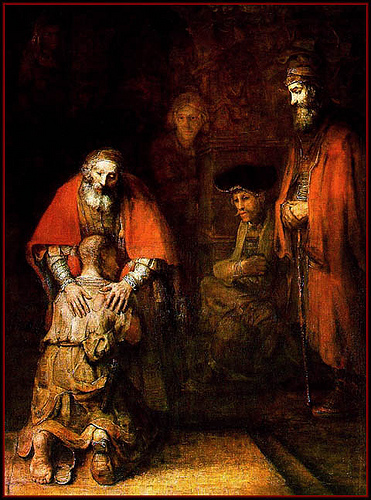
prodigal son

“For God so loved the world….” so goes the most famous of Bible verses. Its reference can be found on posters in end zones at football games. Its short message”God loves you” can be found on bumper stickers and coffee mugs, and its greeting is repeated in church services all over the country. God loves you…yeah, so what? It seems to have become a trite slogan, a shallow sentiment, a cheap Christmas present.

How many times have you heard this phrase? I’ve heard it so much that it seems to have lost its meaning. It’s fallen not so much on deaf ears, as unhearing ears; like when water falls on polyester, those words bead up and roll right off my ears.  My ears are a poor conduit to my heart and mind in relaying the profound magnitude of the simple fact that God loves me. This Person, Who many of us believe in, loves us. Wow! The One who not only defines Love, but is, quintessentially, Love. All that we cherish in life originates with this Being who happens to, according to the Bible record, love us.

How can a simple phrase carry such power? A couple years ago, I was at work and it was toward the end of the day. It was March. As I was sitting at my desk, a text came from my son-in-law. It was a photo and it was uploading. I wondered what he could be sending me. Now mind you, I was just sitting there finishing up some work, looking forward to going home. Within seconds after I received the picture – a sonogram scan with a lovely caption “Congrats Grandma!” – I was crying, afraid, excited and stunned all at once. The couple that was not going to have children was going to have a child.

I use that example to illustrate how a simple communication can dramatically change one’s life. So does “God loves you” and as it should be. God loves you….from the gospel writers, Paul, the early fathers and down through history, this is the church’s banner. A banner she has dropped over the centuries, but a fact nonetheless. A fact that has survived.

If you want to believe, if you chose to believe or even are compelled to believe like C.S. Lewis did when “in the Trinity Term of 1929 I gave in, and admitted that God was God, and knelt and prayed: perhaps, that night, the most dejected and reluctant convert in all England” then you get to unwrap the greatest of all Christmas presents – the love of God in Christ Jesus. This is the greatest gift. Ever. The price – well, that’s the Easter Story.

And there are other gifts in that box, you get the light of the world, the fountain of living waters, the gate to the pasture, the bread of life, mercy, grace, faith, hope and charity to name a few of the unsearchable riches in Christ. Not a bad haul.

Are you tired? “Come unto to me all who are weak and heavy laden.” Are you doubtful? “Come, let us reason together.” Are you thirsty? “Let him come to Me and drink.” Are you lonely? “I will be with you always.” Are you shackled in sin? “Neither do I condemn you, go and sin no more.” Amen. And to the church today, tomorrow and everyday, I say, “Come let us adore Him.”We only know love because He first loved us.

God loves you, so what? Well, that’s what. The greatest of all simple sentences is gloriously true and life-changing. Merry, merry Christmas!


My Miracle

miracle

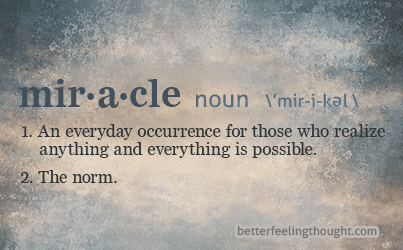
The topic in my online writing group this week is “Miracles”. At first, I thought, “Yikes, I don’t know much about miracles.” But today I remembered one.

I have a lot of kids, and getting them through school has been trying to say the least. There are a couple, THANK GOD, that got up in the morning, got ready and went to school. NO DRAMA. They even did their homework without any assistance from yours truly. Then there were a couple kids that…well, let’s just say they were allergic to that particular routine.

One daughter, in fact, high school hopped. No that’s not a dance. She was particularly gifted in attending as many high schools as she could in four years. A rather noteworthy feat. We were very happy when she graduated from the sixth school she’d been enrolled in. Then her little sister, not to be outdone, began the hop as well. I’m sure Sherry Segalas in our District Office was sick of seeing me. But this one just didn’t like the hop, didn’t like school at all; no hop, no nothing.

One of my miracles this year was getting her in school that would stick. At the beginning of summer, I was resigned to the notion she would just take the CHSPE and get out of school early. But because one of her friends attended a school in the District where I worked, she asked to go there. Well, that wasn’t too easy of a task since it was an alternative school that took in students only from our District’s two high schools. I told her I’d look into it, and promptly forgot about it until July.

She asked about it in July and accused me of not caring about her education (HAH!). I looked into it and the fella I needed to contact was on vacation until the first week of August. And I forgot about it again. The week school was to start – it started on a Wednesday – subject child asked if she was going to the school. Whaaat? Uhm…let me look into it. Now here is the miracle part: I emailed the fella, he got back to me immediately, said I needed an inter-district transfer (which definitely takes time) and I needed to meet with the principal….before Wednesday. It was Monday.

I sent the inter-district transfer to my BFF, SS, to which she replied in no time with a signed release…Yay!! The next day we met with the principal, got her transcripts from local high school and et voile…she was in and she was there for the first day of school. Miracle, plain and simple, just in case the Pope was wondering.

She has done so well in this school, has been on the top credit earner list, scored high on a college entrance exam and has been embraced by the school staff. She will definitely graduate early, not just passing the proficiency test, but with a high school diploma. I could not have asked for a better fit.

Parents with these kinds of kids will appreciate this little miracle. So when things get tough, remember what Philips Brooks wrote:

“Do not pray for easy lives. Pray to be stronger men. Do not pray for tasks equal to your powers. Pray for powers equal to your tasks. Then the doing of your work shall be no miracle, but you shall be the miracle. ”

Amen!

The Weary World Rejoices!

Christmas 2022 – Merry Christmas from the Shoe!

November 2019 – Even now, more so, we need to remember these lyrics.

Previously posted – December 2011

“The weary world rejoices!” say the lyrics of “O Holy Night” “Weary world” – he got that right! I’m tired, aren’t you? Just listening to the news every evening wears me out. Economic distress, social unrest, solutions that are obscure at best dominate the newscasts contributing to a weary mood, to a weary world. And, alas, it’s Christmas time. A time of cheer, excitement and joy. But the weariness remains, aches if you will, like a tooth just starting to pain.

I confess my children help me maintain the joy of Christmas. They are still young, they are still creating those holiday memories that will pleasantly haunt them in adulthood. For them, I can slough off my weariness and sing…and bake and shop and wrap.

But Christmas isn’t about me or the kids; it is about Someone’s birthday. Someone whose humble birth in a barn two millennia ago changed the world.  C.S. Lewis wrote, “The birth of Christ is the central event in the history of the earth – the very thing the whole story has been about.” Remembering that and what He did and what He said grounds me.

Remembering the things He said: “I have come that they might have life.” and “Come unto to Me, all who are weak and heavy laden, and I will give you rest.” and one of my favorites, “I am the way, the truth and the life….” He was, and He continues to be. Amen!

The gifts and the glitter, the lights and the laughter and the music and the magic are sweet by-products of this “central event”. Although these delightful paraphernalia of the holiday give a sense of joy, beauty and excitement; it is fleeting like the energy from a Snickers bar.

It is this historical event that gives the weary world true and permanent joy, true and permanent hope and true and permanent peace. His birth is “the good tidings of great joy”. And that joy spills over into every area we allow it. Not a fleeting feeling of happiness, but a deep abiding joy. A joy that can endure hardship, a joy that can sustain tragedy and a joy that can hope during the dark night. A joy I define as an internal place I liken to a plateau I have reached after a long and arduous hike. It may be stormy or it may be sunny; but regardless, I have reached a higher land and fresher air.

The true meaning of this blessed holiday brings greater joy to happy Christmases and comfort through the inevitable sad and lonely ones. This Christmas I hope your joy will deepen and provide greater comfort and peace to you and your family and friends. Happy Christmas from the Shoe.

And My Soul Felt Its Worth

o holy night

How many of you have looked into the mirror and been disappointed with the reflection? How many of you have resented the reflection? How many have experienced a violent contempt with the reflection? Disappointment, yeah, I get that; but contempt and hatred, that’s not right. I had a problem with self-loathing for a long time.

In my twenties, I didn’t even know I had a problem, I just thought that was the way I was. One moment I was trying to be confident and in control, the next moment I was filled with self-condemnation and guilt. I brought these emotional saboteurs into my marriage without realizing their influence and power. Although having children helped me focus on others than myself, it would become apparent that these components were not going anyway. Little did I know there was another element lurking around my dark emotional closet: shame.

When the beauty of my dreams was being suffocated by the ugliness of my reality, these powerful voices of self-loathing and contempt became loud and unrelenting. Eventually my marriage ended, and my family had a time of refuge and a fragile peace. However, when funds ran out and the neighborhood became dangerous, I moved in with family in hopes of resettling on the Peninsula. Little did I know I was fleeing the frying pan only to jump into the fire.

It was not a good fit, but there was no alternative at the time. Within three months of living with family members, I was so low that I felt I did not deserve to exist. I could not afford to live. I had absolutely no value whatsoever since I felt that value came from earning money, and I had none.  I was on welfare, I had no current skills to get a job having been home for twenty years with kids.  I was face to face with failure, economic hardship, and profound feelings of worthlessness. Nevertheless, without these realizations, I would not have experienced the greatest growth of my emotional life.

Around this time, I was reading Anne Lamott’s Traveling Mercies, and I read this quote, “You don’t have a soul. You are a soul. You have a body.”  This truth sunk deep within in me and that is the point where I began my journey out of the pit of self-loathing toward a healthier self-respect.  I blamed myself for so much, my husband’s drinking, my parents’ unhappiness, my kids’ suffering, etc. Typical Catholic guilt….but it wasn’t guilt, it was a shame so heavy and pervasive that it had invaded all areas of my life and was at the very center of my being, but I didn’t know that yet.

Over the next year and a half, I gradually grew, I began to treat myself as if I were a close friend.  I would never say to my friend the things I said to myself in the mirror.  I stopped the mirror talk, and I began to grow.

One night, five years ago, my little girls and I were randomly quoting Scripture – something we never do – but it was fun. They had memory verses from school.  Ellie quoted Zephaniah 3:17, “The LORD thy God in the midst of thee is mighty.”  I had heard this verse before, but this evening it stuck and I reread the entire verse.

For the Lord your God is living among you.
    He is a mighty savior.
He will take delight in you with gladness.
    With his love, he will calm all your fears.
    He will rejoice over you with joyful songs.

Zephaniah 3:17 – NLT

And what I could only call a moment of grace I could see God Himself singing over me in love in the same manner I express my love toward my kids.  I could understand that from being a mom, and even better, I could feel it.  It was an overwhelming moment.

Around the same time, I read Brene Brown’s The Gifts of Imperfection. When she started talking about shame, I realized how much of my emotional make-up was shame related, not just guilt. I finally could  see it.  I had been blind in shame for so long.

Not long after I read that book, one night, there was an argument going on at the house, and I went upstairs to help broker a peace, but only created a greater skirmish. I went downstairs feeling like I had always felt: crappy, worthless and unable, as a Christian, to make things right, better or even bring peace.

As I stood in the hallway, I had an epiphany. I came to the understanding that a lot of our family’s emotional dynamics were shame-related. A family member, unable to take responsibility for their actions, perhaps from their own pain no doubt, had, for years, shifted their shame and guilt to other family members including myself. I can’t tell you how earth shattering this illumination was. It was like that apron the dentist puts on you, the leaden one for x-rays, and that God took this leaden apron of shame off of me, and I floated to the the surface and breathed the fresh air of freedom and non-condemnation.

At the same moment, almost audibly, I could hear Paul’s glorious and resounding ruling from Romans: “Therefore, there is no condemnation for those is Christ Jesus.”  I had been a Christian for thirty years, and that night I felt like a new Christian, I had been born again again, the decades seemed to fall away, and I was basking in the love and acceptance of the Heavenly Father.

Now I know what Paul means that there is no condemnation, no condemnation from the guilt of my own or others’ sins. I know now what it feels like to be loved by God and be freed from shame and guilt. Thirty years as a Christian and I never felt like I did on that December night. Oh what a night, O Holy Night!

We Need a Little Christimas…Music

I know this is a little early, but I’ve already started parking the XM Radio on Station #18. During this National Blog Posting Month, I am republishing some of my articles that are not on the blog yet. This post is from a December 2011 Patch column.

I think it was the week before Thanksgiving this year that I heard the first Christmas song on the radio. To me, that is the shot that starts off the holiday shopping, baking, partying and show-attending race. It is on, and I am not ready. This year, like in recent ones, “I’ve grown a little older”, “a little sadder”, not much “a little leaner”, so to dispel this post-Thanksgiving funk, I put this Johnny Mathis tune on replay until some Christmas joy was mustered.

In no time I was snapping my fingers and tapping my feet.

The music kicks off the season more than the shelves stocked high at Target or Walgreen’s or even the Black Friday frenzy. It is also a great opportunity to teach our children or our younger relatives about some of the great singers of the past. When asked who Bing Crosby was, my daughter replied, “You mean Bill Cosby.” “Uhh…No.”  I have a lot of work with that one. But to my credit, my oldest does love Frank Sinatra, Dean Martin and Nat King Cole.

It’s time to dust off those funny round black things we used to play day in and day out and enlighten this generation with the voices that imbue the anticipation and wonder we experienced during past holiday seasons. I remember Bing Crosby and David Bowie singing together, and thought, how nice, a song that brings generations together. Well, not anymore as far as the youngsters are concerned, they both belong to the same generation: old people and really old dead people.

Christmas music is a medium I use to pass down family traditions. Every year I watched “White Christmas”, and knew all the words to Bing Crosby’s timeless classic. At church, I sang hymns that have been sung for decades set to music created by the likes of Handel and Mendelssohn. Even today, singers are creating new Christmas classics like Reba’s “Mary, Did You Know?”, Celine Dion’s “O Holy Night” and (I confess) Disney’s Drew Seeley’s “I’ll be Home for Christmas” as well as 98 Degrees’ “This Gift”. Evie’s “Come On Ring Those Bells” was a record I played for all my kids every year. A couple of years ago, we watched “This Christmas” and I found an old favorite Christmas song, Stevie Wonder’s “Twinkle, Twinkle, Little Me”. I was 12 years old all over again. It’s a good opportunity to give a little history lesson too.

So once we are in the full swing of Christmas music, I will take advantage and slip in the songs by these artists, maybe something will rub off. Whatever songs or music embodies the warm and happy memories of your holiday seasons, be sure to share them with your loved ones, especially those younger ones. Have a great holiday season!

A Kind and Resourceful Friend

prc

These words are as true as they were four years ago. Marina and her crew continue to work tirelessly for those in need in our community. THANK YOU!!

November 2011

Three and a half years ago, I returned to Pacifica from the East Bay. I lived there for 15 years, and had hoped to finish raising my kids over there.

However, circumstances drove me from my home to return to the area where I was raised. Most of my family lives on this side of the Bay. Once I got my children situated in school over here, I thought it would be a breeze getting a job. This was in the fall of 2008. After three dozen resumes, I still was jobless and was forced to find some assistance.

I don’t remember how I heard about the Pacifica Resource Center, but I went there feeling very defeated and hopeless. I always tried my best to take care of my bills and my family’s needs on my own. But now I was in a situation where I needed outside help. I tried to put off getting assistance because I could do it on my own, right? Well, not always, and not at this time.

I met with Marina at the Pacifica Resource Center and she signed me up for Second Harvest. She, in her sympathetic and understanding way, helped me with some groceries and informed me of other programs throughout the county. However, there were things that Marina failed to do. She failed to pass judgment, act smugly, or look down on my circumstances. She was very compassionate and caring. For that I will always be grateful.

The Resource Center helped when my children went back to school the following fall. They helped with backpacks, school supplies and gift cards for necessary clothing items. They helped with extra Thanksgiving food boxes, and they have a special Holiday Gift program also.

During this time of Thanksgiving, I am thankful for not only the help my family has received from the Pacifica Resource Center, but the intangibles too. I am thankful for their kindness, their thoughtfulness and their genuine concern for me and my family’s well-being. Marina has always greeted me with a smile, and is always enthusiastic about my family’s progress.

For those who give to charitable organizations at this time of year and you are undecided to which you should give your money, I would like to suggest the Pacifica Resource Center. During these hard economic times, the Resource Center is greatly needed and is a haven for those of us who need more than staples.

Kindness, thoughtfulness and hope are all commodities we need and happily they are without an expiration date. I am glad I have a kind and resourceful friend in Marina and the Pacifica Resource Center.


Things I Hate About Motherhood

crazy

I love being a mom. Not that I’m really good at it, but I like it. I like my kids, and they give me a lot of laughs and joy. Yet, there are a few things I hate about motherhood that are pretty typical, but was ignorant of when I started the journey. I’m not talking about the labor and delivery, even though that was challenging or even the sleepless nights, what I am talking about are events further down the parenting road.

Fighting

Probably number one on the list is fighting among the kids. They fought when they were little too. I was happy to move into a three bedroom house, then I had enough corners to put them all in.

A characteristic that doesn’t particularly bother me about one kid wreaks havoc on another. Then it becomes a bickerfest. And you’re mad at both, even the whiner. Sometimes just playful banter among them can turn on a dime. My college roommate shared some wisdom from her mother, “Laughing turns to crying!” So true. I hope as they get older, they will learn to be patient with each other. I’m being patient waiting.

Guilt

I don’t think there is any parent that doesn’t feel guilty about how they’ve raised their children. Folks say, “You did the best you could.” Well, not really. I did try, I tried hard. But I don’t think I did my best, I could’ve done better, but I didn’t. But I tried. I get an A for effort. We’ll see how the Lord grades me later on.

Navigating through the teenage years, I’ve had to acquire a skin of armor against the guilt trips from the kids. Kids can make you feel guilty almost as bad as parents or the church. But I’ve come to an age where I stand by my decisions and am courageous defending them. Hopefully, the kids will appreciate the good things.

Letting Go

I didn’t think it would be so hard when the kids flew the nest. Even when the first one left and there were still at least nine in the house, sometimes we had extras, I missed that one.  Each time a child moved on, I was so sad. I worried whether they could make it out in that big bad world. But, they ended up doing OK.

I feel bad for my youngest ones. You see the older ones just had to get use to these  new people coming into the family when the little ones were born; but, the little ones have to watch their siblings leave them. Siblings that they became close to, siblings who were their best friends. I knew it was sad for me, I only realized lately how sad it is for them too.

Aside from the things I hate about Motherhood, the things I love truly outweigh these difficulties. Of all the things I’ve learned while mothering, learning to love and be loved is foremost the best thing.

“You’ll Never Be This Young Again”

50th-birthday-cake_2920538b

A college friend gave me a birthday card in my senior year at St. Mary’s College, inside was the quotation referenced above. Since I was a little older than the rest my classmates, the quote was rather ironic. I thought I was ancient at the ripe old age of 27.

Many years ago, I reached an important milestone, my (gulp…big gulp) fiftieth birthday. Turning 30 was no big deal, I had just had my second child and at 40, I was still having babies and too busy to notice, I felt like 19 anyway.

Well, 50, on the other hand, loomed before me like a dark ominous storm over the ocean. I don’t feel like 19 anymore, I can’t see as well, I have panic attacks, my hair is thinning on my head and thickening on my upper lip. It is graying as I write like one of those weird death scenes from “Raiders of the Lost Ark”.

I dreaded 50. But I have to remind myself, “I will never be this young again.” When I am 65, I can look back at 50 like I look back at 27 now. Oh my, I was sooooo young then. There is a lot to be thankful for, I am not on any medication, perhaps I should be; I can still recognize each of my kids and remember their names and even their ages. I have some stamina left to keep up with them and with a smile to boot.

I still daydream when that romantic song comes on the radio. I cry when the “Marseilles” is sung in “Casablanca” or when I hear “Danny Boy” played in March and always when I hear “The Star Spangled Banner” before the few ballgames I watch. I still stop and watch when it looks likes an awesome sunset, I smell the daffodils and I try to hear  what my kids are saying and to remember my parents’ stories.

I like what Victor Hugo wrote when he was over 80 years old, “Winter is on my head, but eternal spring is in my heart. I breathe at this hour the fragrance of the lilacs, the violets, and the roses as at twenty years. The nearer I approach the end, the plainer I hear around me the immortal symphonies of the worlds which invite me.” Although winter, I hope, is not yet on my head, just a lusty crop of fall, I do want to grow old in that manner, filled with the wonder of the experiences of youth, but in tune with the sounds of the hereafter. But for now, I will enjoy being as young as I am!


Beasto and Bob

hamster

Beasto is a boy. His name isn’t really Beasto, but Evaristo. And someone called him Beasto one day, and now everyone calls him that. He calls himself that too. Bob is a hamster. Just Bob, not Robert, just Bob.

Beasto loves Bob, and Bob loves Beasto. They are best friends. Beasto got Bob at the pet store. He wanted a pet, maybe a baby chick, or a turtle, or a hamster. Beasto looked at the chicks at the pet store. They were cute, but he didn’t want a chick. Beasto looked at the turtles in their aquarium. They were cool, but Beasto didn’t want a turtle. Beasto looked at the hamsters in their cages. He held one, he petted it, and he liked the way it felt in his hand. They were soft and cuddly. He bought one and that is how he got Bob.

Beasto took good care of Bob. Beasto and Bob became best friends. Beasto made sure Bob had food and water everyday. He cleaned Bob’s cage every other day. Beasto fixed Bob’s wheel when it broke. Bob loved his wheel and spent a lot of time running on it. Sometimes he slept on his wheel. Beasto took Bob for walks around the yard using a piece of yarn for a leash. They watched TV together. Bob sat on Beasto’s head while he played video games. They were such good friends.

One day, Beasto took Bob to the hilly part of the front yard. Beasto had been digging a small tunnel for Bob to play in. After his tunnel was finished, he told Bob to go through it. Bob went into the tunnel, but did not come out the other side. Beasto looked into the tunnel from both sides, but could not see Bob. Beasto became afraid. He called Bob; still Bob did not come out. Beasto called his sister and brother to help him find Bob. Together they dug and dug to make the tunnel bigger. Maybe Bob got stuck, they thought. When they dug open the whole tunnel, they saw a lot of other tunnels. Bob was gone; they did not know which tunnel he went down.

Bob could hear them digging, but the tunnel he went down was covered with dirt. He waited for them to open the tunnel, but they could not see it. They dug for hours. Bob waited for hours. Beasto could not find Bob, and Bob was waiting to be found. That night Beasto was very sad that he lost his friend. He felt bad that he did not take better care of Bob.

Bob was finally able to dig open the tunnel he was in. He looked around, it was already dark. He looked down the hill to the house. He could see Beasto through the living room window. Beasto looked so sad. Bob called out to him, “Come and get me! Here I am.” Beasto could not see or hear Bob up on the dark hill. Beasto said a little prayer as he sat on the couch looking up to the hill. Bob heard some scary noises and ran down into the tunnel. That night he went exploring.

After a long walk down the tunnels, Bob met a gopher family and was invited in for dinner. Bob told the family all about his friend, Beasto, and how he got lost. The gopher family asked him to stay with them because they thought he would never get home to Beasto. “No, thank you, I am going to find my way back to Beasto. Thank you for dinner, but I must go now.” Bob found his way back to the top of the hill, but everyone was asleep in Beasto’s house. By morning, Bob found a little cave and went to sleep.

Right after breakfast, Beasto went to the hill to dig some more. He spent all day on the hill waiting for Bob to come back. But, as you know, hamsters are night animals, so Bob slept all day while Beasto waited for him. That night Beasto was looking up at the hill again, and Bob came out and called to him, “I’m here, come and get me.” But Beasto could not see or hear Bob, and then Beasto went to bed. Bob went exploring again. He met a different gopher family and was invited to eat again. He told them the story of Beasto and the things they did together. Just like the first family, they invited Bob to live with them. “No, thank you” he said, “I am going to find my way back to Beasto. Thank you for dinner, but I must go.”

Many days and nights went by. Each day Beasto went to the hill and thought about Bob. Each night Bob came out of the tunnel and called to Beasto.

One night, Beasto traveled far into the tunnels. He forgot which tunnel he came down and was really lost now. He came to another gopher family’s house, and they invited him to dinner. Just like the other families, he told them his story and they invited him to stay with them. He told them that every night he was able to get back to the hill, but now he was really lost. Just when he thought he might stay with this family, Grandma Gopher suggested he take another way out of the tunnels, but warned him to be careful of the raccoons.

Bob followed her directions and he found himself near the back porch of Beasto’s house. He was so thrilled because he could see Beasto’s mom and sister in the kitchen, and he was going to run to the porch when five very large raccoons came down the pine tree. Luckily they did not see him and he ran back into the tunnel. Bob could hear the commotion in the house because Beasto’s sister saw all the raccoons. They came to the back door and made a lot of noise to scare the raccoons away. After the noise died down, Bob stuck his head out of the hole and began to scurry toward the porch. It looked like everybody had gone back in; Bob was getting sad when he heard a scream.

“Bob!! Bob!!” Beasto’s sister screamed.

She grabbed him and was running toward the house yelling for Beasto. She brought Bob to Beasto. No one could believe he survived ten days in the tunnels. But he did. Beasto was so happy he almost cried. Everyone hugged and kissed Bob. Bob was so excited to be home, he just wanted to get into his cage, eat and go to bed. Beasto fed Bob, and Bob gobbled up his food.

That night Beasto went to sleep with a smile on his face, and Bob went to sleep with a lot of food in his cheeks.

Beasto